
Protected Areas
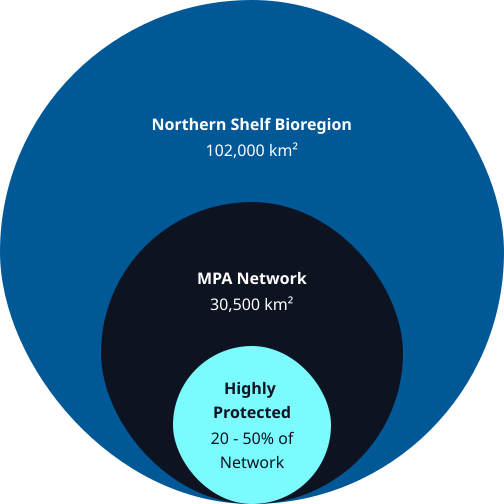
The Great Bear Sea MPA Network builds on existing conservation in the region and covers 30% of the Great Bear Sea / Northern Shelf Bioregion.
Photo by Coastal First Nations
Progress Explained
More than 60% of the Network is comprised of existing MPAs, with the remaining area to be made up of new sites.
The MPA Network aims to achieve significant conservation and economic outcomes while placing high protection and restrictions on only 6% to 15% of the Great Bear Sea region. The design strategies from the Network Action Plan recommend that 20% to 50% of the Network be captured in areas of high protection.
About The MPA Network ➝
Benefits & Impact ➝
FAQ ➝
Stages of Site Establishment
1. Proposed / Committed
The site has been identified for conservation, and conservation is the primary objective of the site. The intention to designate the site has been announced in some formal manner. However, the announcement is non-binding.
2. Designated
The MPA is established through Crown government legislation and/or Indigenous law. The MPA has clear boundaries established for the long-term conservation of the area. The goals of the site’s designation are clearly defined and stated, with biodiversity conservation as a primary stated objective. There is a clear process in place to define allowed uses and the associated regulations and rules to control the impact of authorized activities.
3. Implemented
The MPA exists and is operational, not just on paper. Plans for management are activated, and biodiversity benefits can begin to accrue. The MPA has a plan (a management plan or equivalent) for regulating activities. Governance of the MPA exists within a managing body or people group, such as an Indigenous People, government agency, NGO, or shared governance among these. Resource users, such as fishers or tourism operators, are aware of the MPA regulations.
4. Actively Managed
Management and scientific monitoring of the MPA is ongoing and subject to periodic review. Management is able to adapt and make changes as needed to achieve stated biodiversity conservation and other social and ecological goals of the MPA. MPA management is ongoing, with scientific monitoring, periodic reviews, and adjustments made as needed to achieve the goals. There is active and ongoing monitoring, community engagement, and management evaluation.
Implementation Process
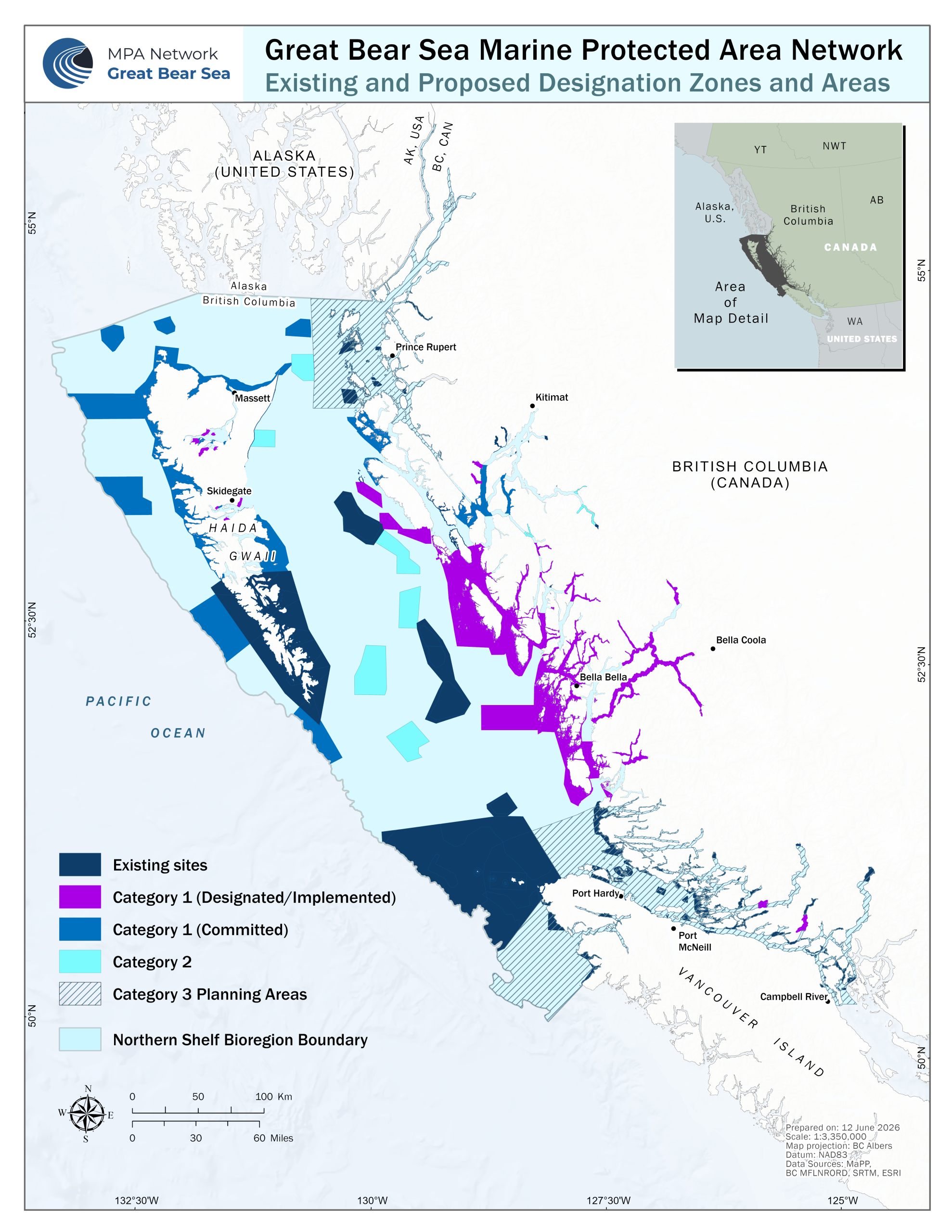
New MPA Network zones have been organized into into three categories, based on the various timelines for implementation:
Category 1 Sites ➝
Category 2 Zones ➝
Category 3 Areas ➝
In addition to the proposed MPA Network sites and zones, numerous existing MPAs contribute to the Network:
Existing Sites ➝
MPA Network site designation progress
The Great Bear Sea MPA Network is made of existing and proposed MPAs, called ‘Sites’. Proposed MPAs are being established on varying timelines.
As of June 2026
| Site | Total Area (sq-km) | Anticipated Designation Date1 | Stage of site establishment | |||
| Committed | Designated2 | Implemented | Actively Managed | |||
| Xaana Kaahlii and Gaw Káahlii Marine Refuges | 29 | 2025 | Complete | Complete | On Track | Not Started |
| Xaana Kaahlii / Gaw Káahlii Land Act Section 16 Withdrawal | 30 | 2024 | Complete | Delayed | Not Started | Not Started |
| Haida Gwaii Nearshore marine National Wildlife Area | 2,268 | 2028 | Complete | Delayed | Not Started | Not Started |
| Haida Gwaii Offshore Marine Protected Area | 3,976 | 2028 | Complete | Delayed | Not Started | Not Started |
| North Coast Fjords Marine Protected Area | 454 | 2028 | Complete | Delayed | Not Started | Not Started |
| Kitkatla Inlet Marine Protected Area | 440 | 2028 | Complete | Delayed | Not Started | Not Started |
| Kishkosh and Kitkiata Inlets Wildlife Management Area | 17 | 2025 | Complete | Complete | On Track | Not Started |
| Banks Marine Refuge | 435 | 2026 | Complete | Complete | On Track | Not Started |
| Mia-yaltwa Ha’lidzogm hoon NMCAR and IPCA | 6,700 | 2025 | Complete | Complete | On Track | Not Started |
| Gwaxdlala/Nalaxdlala Marine Refuge Land Act Section 17 withdrawal & IPCA | 21 | 2023 | Complete | Complete | Complete | On Track |
| Homayno Marine Refuge Land Act Section 17 withdrawal & IPCA | 28 | 2026 | Complete | Complete* | On Track | Not Started |
| Category 2 Zones | 2,779 | 2030 | Delayed | Not Started | Not Started | Not Started |
Timeline
Anticipated MPA Establishment Timeline
2021
- Gwaxdlala/Nalaxdlala (Lull Bay/Hoeya Sound) IPCA Declared
2023
2024
2025
2026
2027
2028
2030
- Category 2 MPAs Established
2031+
- Category 3 MPAs Established