DISCOVER
Category 3 Areas
Category 3 Areas
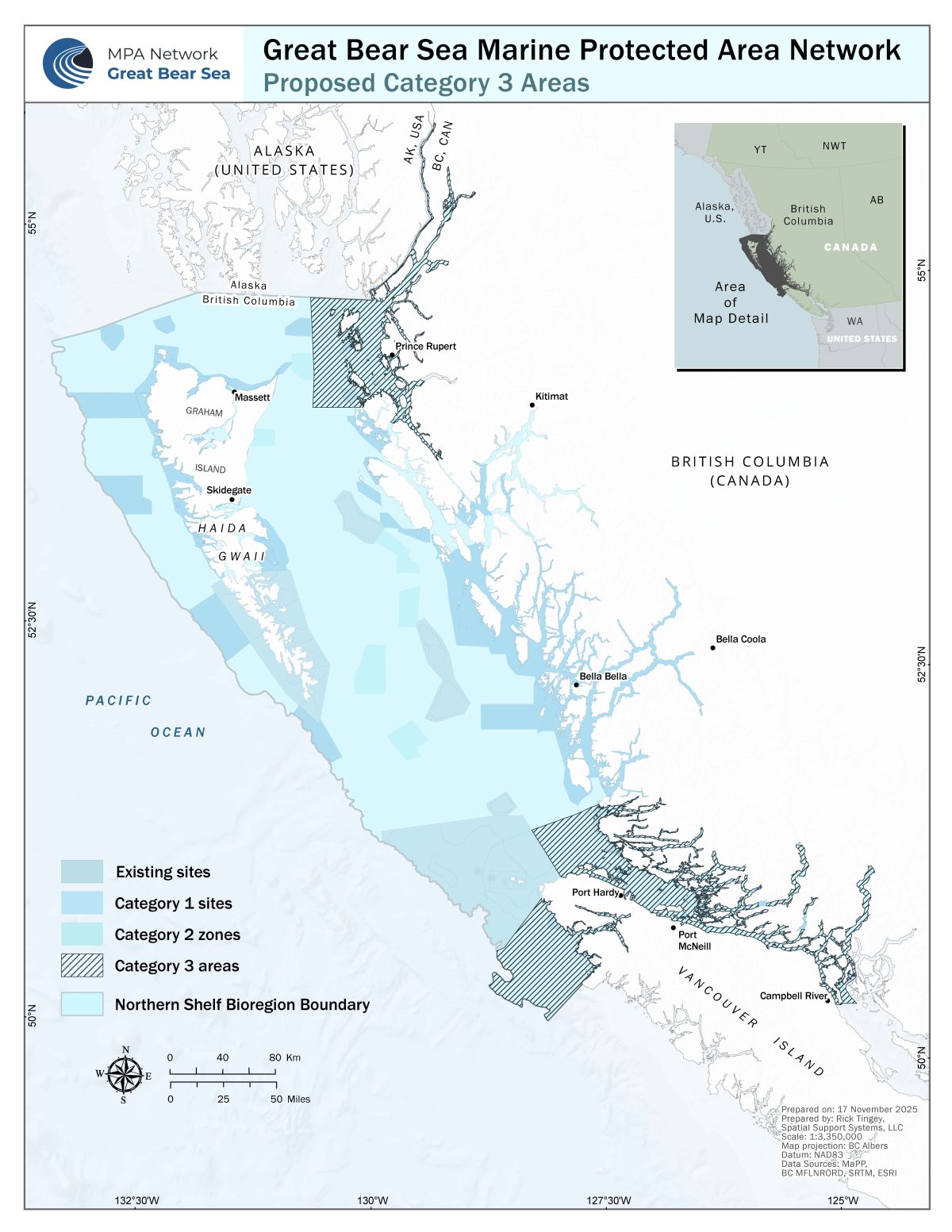
Category 3 areas are recognized as ecologically and culturally important and may contribute to the Network objectives, but further work is required to reach agreement among Governance partners and other potentially affected First Nations regarding how protection will be described and implemented.
Northern North Coast
Description
These zones, located North-east of Haida Gwaii, have been identified as ecologically and biologically significant areas. They are important forage habitat to multiple bird species, including Sea duck, Shearwaters, Fulmers, Loon, Grebe, Storm Petrel and Pigeon Guillemot. The area is biologically diverse and includes many important, rare, unique and threatened species including Pacific Sand Lance, eulachon, Dungeness crab, Grey Whale, Sunflower sea star, corals and sponges, harbour porpoise, and groundfish.
This zone has high cultural and historic value, including Haida Village sites and seasonal camps, and important areas for learning traditional practices. Historically and presently the nearshore area provides an important travel route for Haida to access fishing grounds and other village sites. Moreover, the site contributes to the conservation of species significant to the Haida Nation and coastal communities, including those important for cultural use and food security. These species include, but are not limited to, nesting sites and foraging habitats for marine birds, harvesting of seaweeds and kelp, herring and herring roe on kelp, marine invertebrates, and fish.
North Vancouver Island (NVI)
Ecological context
This area encompasses the western portion of Vancouver Island from Brooks Bay north, and eastern portions from Campbell River north. It also encompasses islands including Quadra Island, Read Island, and the Broughton Archipelago in the south, and north to Hope and Nigei Islands. The many inlets on the mainland, including Bute Inlet and Phillips Arm in the south, and north to Smith Sound, are also within this area, with the exception of portions within Loughborough Inlet and Knight Inlet (where Category 1 sites are proposed).
With its diverse characteristics of highly productive estuaries, high quality aquatic environments that support both spawning salmon and resident fish species, sandy beaches, steep mainland fjords, sheltered bays, and strong tidal currents, this area provides a variety of ecological uniqueness. NVI is an interface of two major bodies of water and complex shorelines, which affords a rich and diverse marine environment with rare species and migratory birds using the variety of habitats for spawning, breeding, or rearing.
First Nations cultural context
The area is critically important to local First Nations, both culturally and spiritually, and for the harvest of marine resources including eelgrass, birds, crabs, salmon, shellfish, and herring. There are many sites of cultural and spiritual importance to First Nations in the area, including several historical and present village sites, fishing and hunting grounds, and locations for collection of various plants and medicines used throughout the seasons.
Human use context
This site is a regionally important destination for marine recreation. Recreational opportunities include scuba diving, kayaking, fishing, wildlife viewing, beachcombing, and boating. There is significant recreational salmon fishing in the area and several sheltered anchorages for small boats.
This is also a significant area for commercial uses, including various fisheries, aquaculture, and tourism. It is important for gillnet, seine, and troll salmon fisheries, and some rockfish and shellfish (prawn, urchin, crab, sea cucumber, scallop) fisheries. Industrial uses include log handling and storage and transportation, among others.
| Network Sites Progress | Total Area (sq-km) | Anticipated Designation Date | Stage of site establishment | |||
| Committed | Designated | Implemented | Actively Managed | |||
| X̲aana K̲aahlii (Skidegate Inlet) and G̱aw Ḵáahlii (Masset Inlet) Marine Refuges | 29 | 2025 | Complete | Complete | On Track | Not Started |
| X̲aana K̲aahlii / G̲aw K̲áahlii (Skidegate Inlet/ Masset Inlet) Wildlife Management Areas | 30 | 2024 | Complete | Delayed | Not Started | Not Started |
| Haida Gwaii Nearshore Marine National Wildlife Area | 2,268 | 2028 | Complete | On Track | Not Started | Not Started |
| Haida Gwaii Offshore Marine Protected Area | 3,976 | 2028 | Complete | On Track | Not Started | Not Started |
| North Coast Fjords Marine Protected Area | 454 | 2028 | Complete | On Track | Not Started | Not Started |
| Kitkatla Inlet Marine Protected Area | 440 | 2028 | Complete | On Track | Not Started | Not Started |
| Kishkosh and Kitkiata Inlets Wildlife Management Area | 17 | 2025 | Complete | On Track | Not Started | Not Started |
| Banks Marine Refuge | 435 | 2026 | Complete | Complete | On Track | Not Started |
| Central Coast National Marine Conservation Area Reserve | 7,064 | 2025 | Complete | On Track | Not Started | Not Started |
| Gwa̲xdlala/Nala̲xdlala Marine Refuge, Land Act Section 17 withdrawal & IPCA | 21 | 2023 | Complete | Complete | On Track | Not Started |
| Homayno Marine Refuge, Land Act Section 17 withdrawal & IPCA | 28 | 2026 | Complete | On Track | Not Started | Not Started |
| Category 2 Zones | 2,779 | 2030 | On Track | Not Started | Not Started | Not Started |